
The San Diego Union Building
Next door to the Casa de Pedrorena is the home of San Diego's first newspaper, The San Diego Union. It was built in 1851 and made out of pre-assembled pieces that were shipped into San Diego from the East Coast. It is now a museum dedicated to the early days of the press in San Diego. Typesetting and printing equipment show how much work it took to put out the news in the early city.
 |
| The San Diego Union Printing Office (Flickr User J. Stephen Conn/CC) |
 |
| Freedom of the Press (Flickr User Adam Jones/CC) |
Mason Street School
Most towns of any size have a schoolhouse. Old Town San Diego was no exception. The Mason Street School was a small one room schoolhouse built in 1865 that served as the towns schoolhouse until 1872.
This building has been around a bit though. When the school moved to a bigger 4 room building the schoolhouse was moved about a half a mile away and used as a private home until somewhere around 1918.
The little schoolhouse then was converted to a restaurant called the Old Town Tamale Factory which served up presumably tasty meals until the late 1940's.
After the restaurant shut down, the building sat idle until being acquired by the State of California, who Moved it again, this time into the developing Old Town area where it was opened as a museum on July 1, 1955.
 |
| San Diego's Oldest Schoolhouse (FlickrUser Jim MooreCC) |
 |
| Come Inside, Class Is About To Start (Flickr User Ming-yen Hsu/CC) |
 |
| Children be Seated! (Flickr User Bonnie Dean/CC) |
Seeley Stables and The Black Hawk Livery
Before cars and highways and Old Highway Notes, and before the railroads were built into San Diego in the 1890's, travel would be challenging. To go to Washington D.C. you could sail South all the way around the tip of South America then head North up the Atlantic Coast. Or you could go half way, to Panama cross the isthmus to the Atlantic Ocean and the continue North on different ship. Or you could go overland.
Overland travel in mid 19th century San Diego often meant travel by stagecoach. Albert L. Seeley was a man who helped address that need in Southern California. It 1868, he was granted a charter for a weekly mail route between San Diego and Los Angeles. Within a year Seeley and partened with another San Diego merchant, Charles Wright. The Seeley and Wright Stage Line had increased the run to at three days a week. It was a two day trip with an overnight stay in San Juan Capistrano. Their service meant you cold leave San Diego at 5am in the morning and arrive in Los Angeles at 4pm the next afternoon.
The Seeley Stables were constructed in 1869 to house his horses and equipment. his business was successful for 8 years, until the Southern Pacific began service from Los Angeles to Anaheim in 1876. He was not the only stagecoach operator in San Diego and the competition combined with railroads impact squeezed him out of business in 1877. By 1920 the stables were demolished. But in 1977 the State of California realized the importance of depicting early transportation in the area and rebuilt the stable to serve a s museum of ,id 19th century overland travel. Today the Museum housed inside features stage coaches, horse tack, farm wagons and other displays.
Behind the stables is the Black Hawk Livery, a reproduction of the Blacksmith Shop that would have naturally worked with such a horse based operation as a stagecoach line. The reproduced livery offer live demonstrations of the type of smithing that would have been performed here when the stable were active.
 |
| Seeley Stables (Flickr User eefeewahfah/CC) |
 |
| A Concord Stagecoach featured in the Museum (Flickr User Jasperdo/CC) |
 |
| A Private Wagon of The Era (Flickr User Jasperdo/CC) |
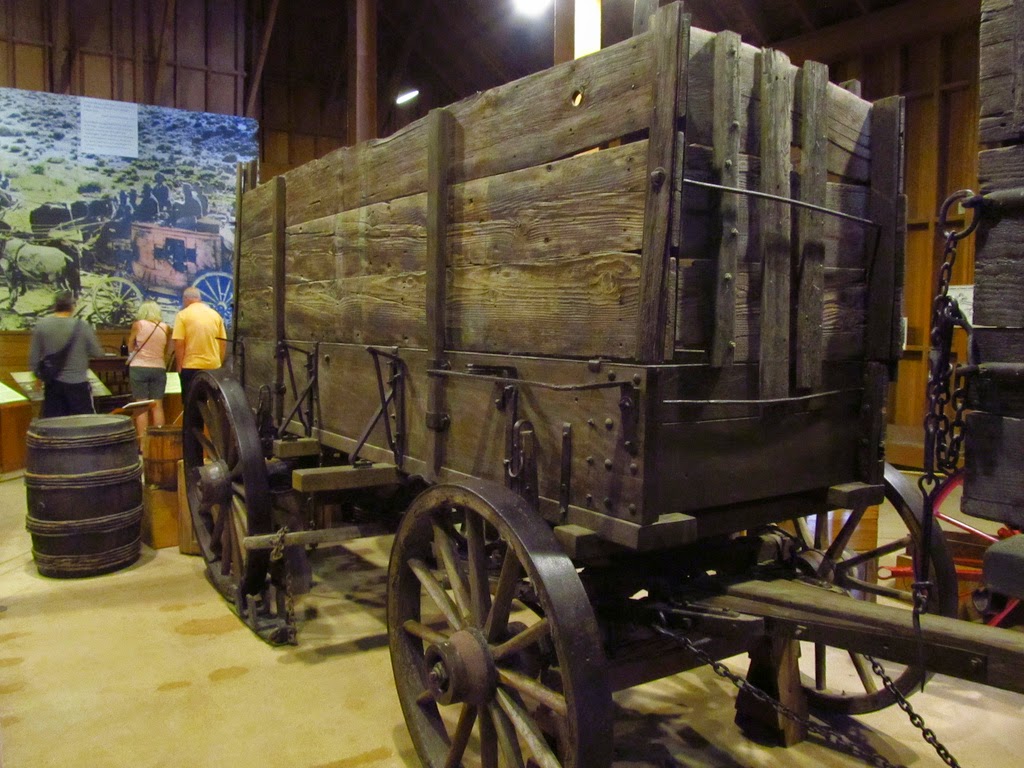 |
| The Big Rigs of the 1800's (Flickr User Jasperdo/CC) |
 |
| Black Hawk Livery (Flickr User Gary J. Wood/CC) |
 |
| The Blacksmith Worked Hard For His Pay (Flickr User Dmytro Kochetov/CC) |
The Colorado House and Wells Fargo San Diego History Museum
The Colorado House was built as hotel in 1850 by Cave Johnson Coots. Coots was Tennessee native and west Point graduate who came West to serve in the frontier. During the Mexican American War he was in California stationed at Los Angeles, San Luis Rey, and San Diego from 1848 to 1851
While stationed in San Diego, Coot began building his hotel. a two story building it had a first floor veranda and a typical Western false box front. Coots became involved in civic affairs serving on the first Grand Jury in 1850. he would later serve as county judge in 1854.
During the Colorado House's construction Coots must have fallen in love. In 1951 he was married to Ysidora Bandini, daughter of his friend Juan Bandini, One of the generous wedding gifts the couple received was land. A tract of 2219 acres was deeded to the newlyweds. The couple would move to their new rancho in 1853.
Throwing himself into his work developing the Rancho, Coots' interest in the Colorado house waned, From 1854 to 1866 he leased out the subdivided building to provide office space for the San Diego Herald, a surgeon, jeweler, hairdresser and other businesses.
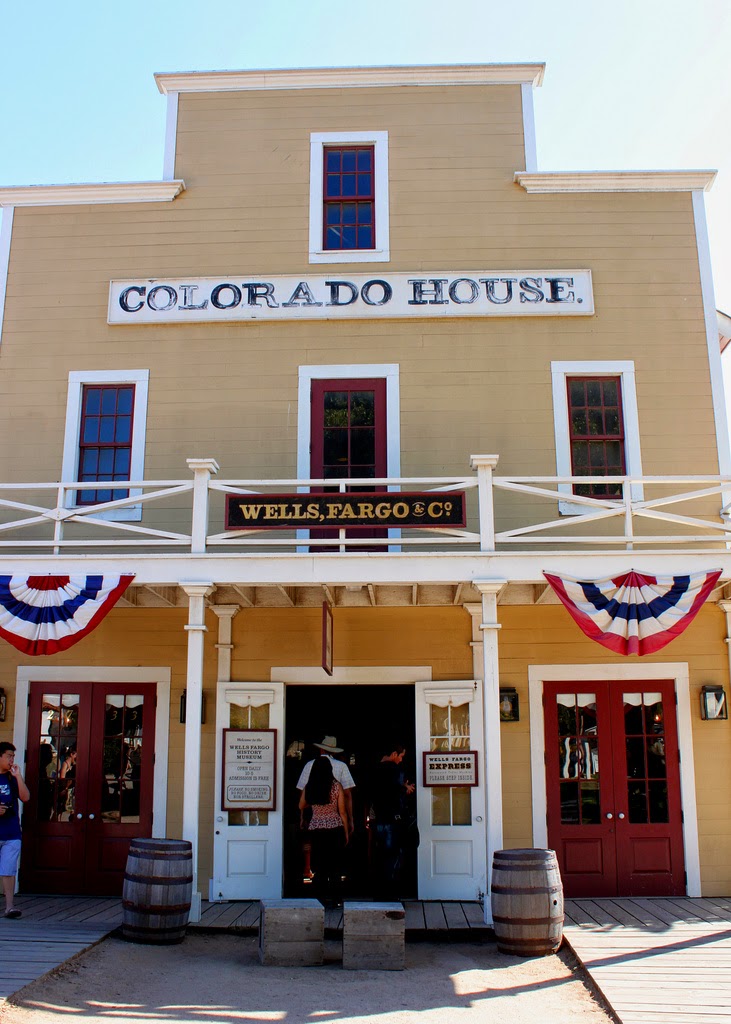 |
| The Wells Fargo San Diego History Museum is in the Colorado House (Flickr User Prayitno / Thank you for (4 millions +) views/CC) |
In 1866, Coots faced legal troubles and was charged with but ultimately found not guilty of the murder of an Indian worker on his Rancho. He would go on to gain land from three other ranchos, becoming on of the richest men in early Southern California.
That same year he sold the Colorado House to Joseph Mannasse and Marcus Schiller. In 1872 it was destroyed by fire. Adding to Old Town San Diego, the building was reconstructed in 1992 where it now houses the Wells Fargo San Diego History Museum.
 |
| TheWells Fargo Wagon Connected The West (Flickr User Prayitno / Thank you for (4 millions +) views/CC) |
Wells Fargo played a crucial role in early California being a leader in banking, shipping, and travel. There famous stagecoaches crisscrossed the young state of California. Its banks provided assaying services to miners in the gold fields. Secure transport of money and passendgers connected the far flung state to the Eastern United States and it commerce.
The museum touches on those early days with t he recreation of an early bank and assay office, with displays of gold rush era mining and banking equipment as well as a large gold nugget n display and one of its iconic stagecoaches.
The San Diego County Sheriffs Museum
 |
| (Wikipedia) |
Any city draws crime. It is the job of law enforcement to protect the peace. For over 150 years the San Diego Sheriffs Department has served that function. In celebration of that history, they too have a historical museum in Old Town San Diego.
From their website:
The Sheriff's Museum consists of 6800 square feet of exhibit space, covering the entire history of the San Diego County Sheriff's Department from its inception in 1850 through today.
The Museum contains cars, motorcycles, real life jail cells from various eras, and replica Sheriff's offices from the 1850's, 1940's and present.
Children will love the Museum - they can sit on a real life motorcycle and use the siren, pick up a bullet proof vest, play with handcuffs, and sit in a real Sheriff's Car!
Adults will appreciate the rich history of the department reflected throughout the Museum. Ask the docent to take a picture of your entire family - locked in a jail cell!
 |
| 1966 Dodge Polera Squad Car (Wikipedia) |
Playlist Additions
This week we have two songs from each of the following themes:
- Newspaper
- School
- Stables
- Horse
- Wagons
- Blacksmith
- Bank
- Bank Robbers
- Law Enforcement
- Jail
Newspaper starts us off with The News from jam band supergroup called Comotion. The group contains members from String Cheese Incident, Leftover Salmon, David Grisman Quartet, Aquarium, Rescue Unit, and the Anger-Marshall Band. Sadly, I could not find it available for download. The CD is available in my Amazon store. All the fancy finger picking in The News leads to a old time country hit from Arthus Smith playing Jimmy Brown, The Newsboy.
- The News Head West Comotion 4:27
- Jimmy Brown, The Newsboy 200 Years Of American Heritage In Song Arthur Smith 1:41
School follows as we mix in some pub rock with Rockpile and Teacher, Teacher. Cat Stevens mellows us out a bit with his nostalgic Old Schoolyard.
- Teacher Teacher Seconds Of Pleasure Rockpile 2:35
- Old Schoolyard On The Road To Find Out Cat Stevens 2:44
Stables are the next theme in the civic life of Old Town San Diego. I was a little surprised to find a few stable songs in my collection.Livery Stable Blues perfectly fits the Seeley Stables. I have several versions of this dixieland classic, I went with a version from the house band in Disneyland's New Orleans Square, the Side Street Strutters. If you want a copy for yourself, you have to go to Disneyland, sorry. Keeping in the jazz vein, we follow with Stablemates by Stan Getz and Kenny Barron. Unfortunately, I could not find videos for either song to share.
- Livery Stable Blues You Ask For It The Side Street Strutters Jazz Band 3:46
- Stablemates People Time Stan Getz & Kenny Barron 8:49
Horses are what a stable exists for. So we have a couple of horse songs. Flatt & Scruggs break it down bluegrass style with Six White Horses. Then we have Oregon's own Misty River with a story of little girl longing in Black Pony.
- Six White Horses Flatt & Scruggs 1948-59 Flatt & Scruggs 2:44
- Black Pony Misty River - Live At The Backgate Stage Misty River 3:37
Wagons and Stagecoaches are why Seeley needed horses and a stable, Our first wagon song is Brett Ratliff's cover of a Grandpa Jones novelty song called Wish I'd Stayed In the Wagonyard about a farmer who comes into town, leaves his wagon at the wagonyard and proceeds to get drunk and in trouble, Another classic wagon song also is a tribute to Wells Fargo, so it just had to make the list.Wells Fargo Wagon from Merediths Wilson's The Music Man is our next addition. My version is from the Original Broadway Cast.
- Wish I'd Stayed In The Wagonyard Cold Icy Mountain Brett Ratliff 2:38
- Wells Fargo Wagon The Music Man Original Broadway Soundtrack Eddie Hodges with Cast Of 'The Music Man' 2:13
Blacksmith songs were in short supply, so I went with his tools to represent the blacksmith shop. Anvil Chorus by Glen Miller and his Orchestra really bangs it out, while a Nine Pound Hammer Is Too Heavy for the Monroe Brothers.
- Anvil Chorus The Best of the Lost Recordings & the Secret Broadcasts Glenn Miller 4:05
- Nine Pound Hammer Is Too Heavy Harry Smith's Anthology Of American Folk Music, Vol. 4 The Monroe Brothers 2:14
Bank songs are more common than blacksmith songs, and frequently they are not pro bank, as you might imagine. Our first song was featured in the Route 66 playlist on this blog. It is by Early Chicago bluesman Big Bill Broonzy and it's the Bankers Blues. A more modern spin on the same idea comes to us from Beck with Canceled Check.
- Banker's Blues Bill Broonzy-01-75 Big Bill Broonzy 2:32 Download Here
- Canceled Check Mutations Beck 3:14
Bank Robbers show up when there is a bank. Our playlist gets an unlikely cover by Hot Tuna as they play the Clash's Bank Robber. Bringing it back to my hometown, Portland's Freak Mountain Ramblers bring their country fried hippy rock sound to a fairly faithful cover of a Jeffery Fredericks and The Clamtones song from 1970's hippy Portland, Robbin' Banks.
- Bank Robber Live At Sweetwater Hot Tuna 4:30
- Robbin Banks III Freak Mountain Ramblers 4:17
Law Enforcement becomes a requirement when you have a crime. Our first law enforcement song is an old time country song from Big Dave McLean, Police and High Sheriff. Cops from the well played The Beau Hunks Play The Original Little Rascals Music pairs nicely as an old time jazz number.
- Police And High Sheriff 35 Years Of Stony Plain Big Dave McLean 1:13
- Cops The Beau Hunks Play The Original Little Rascals Music The Beau Hunks 0:37
Jail. They have one at the Sheriff Museum and you can take pictures there. Nice place to visit, but you would not want to stay there. To close out this weeks playlist additions, we have a bluegrass jailhouse lament, Jailer Jailer, by Peter Rowan. You might remember Peter Rowan as one of the legendary hippy bluegrass band Old And In The Way or as one of Bill Monroe's Bluegrass Boys. Our last song this week is by a fictitious group, the Soggy Bottom Boys. From the film O Brother Where Art Thou comes the Soggy Bottom Boys big hit, an old country classic, Man Of Constant Sorrow.
- Jailer Jailer Legacy Peter Rowan Bluegrass Band 3:38
- In The Jailhouse Now O Brother, Where Art Thou? The Soggy Bottom Boys 3:35
Signing Off and Coming Attractions
I hope you have been enjoying our tour of Old Town. We have just one more thing to see then we will hit the road again. I'd like to hear your opinions about the playlist. Do you prefer individual videos or video playlists? Let me know in the comments please,
Next Week: Our drive North on Interstate 95 in Florida continues. There are more Spring Training baseball fields to see along this stretch of the highway. We will hit one, and see what else Port St Lucie has to offer.
Two Weeks: The story of the Blues Brothers continues to dominate our look at the city of Chicago, Illinois at the start of Route 66.
Two Weeks: The story of the Blues Brothers continues to dominate our look at the city of Chicago, Illinois at the start of Route 66.
Three Weeks: Before we continue North on Highway 101 through San Diego, California we will conclude our visit to Old Town. Their is one more house to see and it has quite a story tied to it.
Mileage Stats
Route 66: 0 Miles/1 State/1001 Tracks/270 Videos/40 Posts
Highway 101: 22 Miles/2 Countries/1 State/614 Tracks/319 Videos/29 Posts
Interstate 95: 123 Miles/1 State/87 Tracks/139 Videos/14 Posts
And Now A Word From Our Sponsor...
If you like what you have read here I'd like to ask you a favor. If you purchase any item on Amazon after you link to them in the Amazon banner below, I will get a little something from them. It doesn't cost you any extra and I cannot see what you have purchased.
With your help, I can keep the show on the road for you.
With your help, I can keep the show on the road for you.
You Can Give me a Karma Donation Via PayPal
Keep Traveling!
To read more Old Highway Notes, choose an off ramp and click on the highway sign:





Vista Points
Be social, Get more info, View our YouTube playlist and more


%20no-repeat;width:110px;height:40px;@media%20only%20screen{background-image:url(https://linkmaker.itunes.apple.com/htmlResources/assets/en_us//images/web/linkmaker/badge_itunes-lrg.svg);}%22%3E%3C/a%3E)

